If you’ve ever Googled “how do I know if my marketing is working?” you’re in the right place!
As a business owner, there are tons of ways to market your business. From allll the social media platforms, email newsletters, blogging, vlogging, and the next new thing that the world will throw at us, it’s easy for a large portion of your time to get scooped up into all of those things.
And I get it – marketing IS one of the most important things that you can spend your time on as a business owner. You want to put yourself out there so that people get to know you and become aware of the products or services you provide.
But after putting in all of that effort, wouldn’t it be such a bummer if you weren’t actually sure which marketing efforts you’re spending all of your time, energy, and money on are working?!
As a marketing strategist, I truly believe only focusing on marketing efforts that make sense and work for you specifically is a much better use of time, as it allows you to do more of what’s working and confidently leave the rest behind!
So, how do you know what’s working? By measuring your marketing efforts! And the best way to do that is by setting up and using a personal marketing analytics dashboard.
Signs Your Marketing Isn’t Working (Before You Even Check the Numbers)
This is the part that’s uncomfy and scary! Starting to realize your marketing might not be working.
Here’s a few things that you’ll start to notice when your marketing isn’t working
- your lead flow will start to slow down
- you don’t know which platforms to spend your time on
- you’ll just feel like you are wandering around in the dark trying to market your business in any way you can.
And when you aren’t sure what’s driving your business it’s so easy to make decisions based purely on emotions.
Your gut feelings can only get you so far, they’ll point you in the right direction, but when it comes to making decisions that truly move your business forward, you need a way to connect the dots between what you feel is working and what actually is.
Your gut might be screaming “It’s not working!” when the truth is, it’s just not working yet.
How to Tell If Your Marketing Is Working?
The best way to tell if your marketing is working is by measuring your marketing efforts. I’m a little biased but I think the best way to do that is by setting up and using a personal marketing analytics dashboard.
Here are a few things you might want to look at to determine if your marketing is working:
Website Traffic Sources
When you know what sources are producing website traffic you can determine where to spend your resources. Take a look at the way you are marketing your business and determine if those efforts are actually driving visits.
Lead Funnel Traffic Sources
Are people opting into your free resources? What sources are those opt-ins coming from?
This is how you keep a pulse on your conversion rates and see what actions produce those results in YOUR business.
Email Open + Click Rates
Email open rate and click rate are your nurture metrics, they tell you how you’re keeping warm leads warm.
Conversion/Booking Metrics
Your conversion metric is your revenue-driver and the one you’ll want to pay the most attention to. It answers: how are people saying “I’m in”?
If you aren’t sure which metrics are for, this blog will help you determine which marketing metrics matter most for your business.
And a marketing analytics dashboard makes measuring so much easier!
What Is a Marketing Analytics Dashboard? Annnnnd Do You Need One?
A marketing analytics dashboard is a tool that consolidates your various marketing data points into a visually digestible format. A one stop shop for marketing metrics that matter for your business.
It’s a visual, simplified view of the data that matters to you: individual, unique to your business.
It does more than just report numbers. It tells a story and helps you spot trends and patterns, so that you can adapt your strategy in real time. Unlike traditional reports or spreadsheets, a dashboard is dynamic, often real-time, and tailored to highlight the information most crucial to your business goals.
It helps you tune into your numbers and your intuition, so you can make adjustments to your marketing campaigns so that you can see what’s working, what’s not, and where to focus next.
Because it’s important to operate in a space that makes the most sense for you as a human, what you use for your marketing analytics dashboard might look a bit different than your biz besties.
Maybe you choose to record your marketing experiments like a story in a journal?
Maybe you choose to record your marketing experiments in a spreadsheet?
Or maybe you’d like to have an automated marketing analytics dashboard?
As long as the marketing analytics dashboard that you’ve set up allows you to track your marketing experiments you are good to go!
Recording your data is wonderful, but taking action is the juice!
Using the 3T Method to answer the question, “How do I know if my marketing is working?”
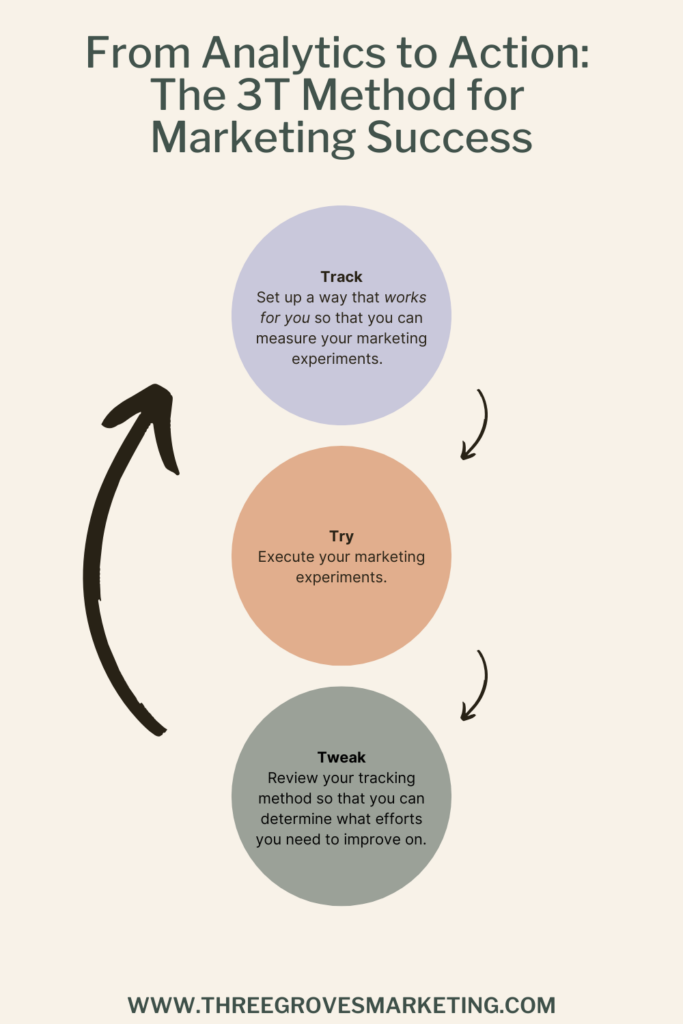
The 3T method is my 3 step method to taking action on your marketing data!
The first step is to track – you’ll need to set up a way that works for you so that you can measure your marketing experiments.
The second step is to try – this is where you execute your marketing experiment.
The final step is the tweak – by reviewing your tracking method you can determine what tweaks you need to make to improve on your last experiment, so that you can try again!
Notice how the process is cyclical.
Step One: Track, where you Identify and Record the Key Performance Indicators (KPIs) for Your Business
Your marketing analytics dashboard should reflect all the things you need to determine if your marketing is working.
Things that are directly related to your ability to make data driven business decisions.
Some of those things might include:
- Where your website traffic is coming from, so you know which marketing effort is directly affecting your visibility.
- What conversion events are happening on your website, so you know which actions people are taking once they are on your site.
- What your most visited website pages are, so you know what your audience is most interested in.
- Which keywords are driving traffic to your website, so that you know how people are finding you through search.
- Lead funnel traffic sources and conversion rates, so you can see where potential clients drop off in your marketing process.
- Sales traffic and conversion sources with conversion rates, so you can tell which marketing efforts are producing paying clients.
If you still aren’t sure which marketing metrics will allow you to make better business decisions check out this blog! It’ll help you determine which 4 marketing metrics matter most to your business.
Step Two: Try, Where you Setup and Complete Marketing Experiments in Your Business
This is the phase of the three step process that is often the hardest.
Why? Because trying is hard (even though we don’t talk about it often enough)
Here is where you will implement your marketing experiment.
An experiment might look like finding out that Facebook groups aren’t resulting in leads, but that Pinterest is, so you make a plan to change how you are currently spending your time — sliding the time you generally spend in Facebook groups to make your Pinterest strategy more effective.
You’ll complete the steps you’ve laid out for yourself and you’ll keep going for the time that you’ve allotted (remember, this is your experiment) whether or not you can tell if your marketing efforts are working.
It’s important to see your marketing experiment through so that you can separate facts from feelings – you’ll use all of your data to determine if your marketing experiment worked inside of the final step of the 3T Method – Tweak.
Step Three: Tweak, this is How to Use Your Data to Tell If Your Marketing Is Working
Here are a few of the things I like to do when I’m determining how to tweak my marketing experiments.
Notice patterns – what first jumps out at me?
This is one of the most important reasons why you want to store your data in a way that works with your brain.
Can you draw patterns by looking at flat data? Maybe a spreadsheet would work for you.
Or do you need a visual representation of the numbers? You might need some charts, friend!
Figure out what created the shift in the pattern.
What marketing efforts, or lack of, attributed to the shift in pattern?
Did something happen that caused the business to gain traction?
Did some things get skipped?
Make a plan to impact the pattern.
This is better explained with some examples:
Maybe you notice that your email subscribers went up and you figure out that you shared on your stories on the days you saw email subscriber spikes. Your plan to continue the positive pattern might be:
- To show up on stories more during the next time period you are tracking, or maybe you think about people you could engage with to do a story swap.
Maybe you notice your email open rates were lower than you’d like. You emailed your list once a week, but upon further investigation you realize your subject lines.. mighta been a bit stale. Your plan to increase your open rates during the next time period that you are tracking could be:
- Brainstorm snappier subject lines
- A/B test them inside your email service provider so that you have twice the data to draw from next tracking period.
Creating a Marketing Analytics Routine
You’ll cycle through each of the steps – Track, Try, and Tweak at a pace that makes sense for you using the KPIs you’ve determined are applicable for your business to make better business decisions.
The thing that makes most people sweaty? Google Analytics!
Google Analytics is powerful, but not exactly user friendly, and can be super confusing. It’s packed with pages and pages of reports, no clear direction on how you should use them, and so much data it’s hard to know where to begin.
If you’ve ever opened Google Analytics, blinked at the screen, and immediately closed the tab I’ve got the workshop for you, “How to Make Sense of Your Marketing Data.“
This workshop is for you if:
- You have GA4 installed but you’ve never really used it
- You’re actively marketing but you can’t tell which effort is bringing in clients
- You’ve tried to figure out Google Analytics on your own and walked away more confused than when you started
- You want data to feel empowering instead of scary
You’re going to leave this workshop with an actual marketing plan built from the data you already have. We’ll look at what’s been working in your business, so that you can do more of what’s working and less of what’s not.
So whaddya say? Wanna snag a seat?

Who Could Help You Make Sense of Your Marketing Data?

Me, Rebecca!
I’m a facts + feelings girlie. I think it’s really important to use your data, but also honor your humanity.
My background in retail sales and ads management taught me that marketing is ultimately about human behavior, and data just helps us understand it better.
Frequently Asked Questions:
How long should I wait to know if my marketing is working?
It really depends on the amount of data that you have! Remember, you can’t measure something that doesn’t move so when you’re thinking about how long you should try a marketing effort before you decide it doesn’t work you really want to think about the amount of times that you’ll do the effort rather than the length of time.
For example, if you’re trying to decide if trial reels work not only do you want to ask yourself, “Did I do this for a meaningful amount of time” but also “Did I also (do the thing) a reasonable amount of times to draw any serious conclusions from?”
What are the signs your marketing is working?
Here are a few things that you might start to notice when your marketing isn’t working
- your lead flow will start to slow down
- you won’t know which platforms to spend your time on
- Your on platform engagement will drop
- you’ll just feel like you are wandering around in the dark trying to market your business in any way you can.
Is my marketing working if I’m getting traffic but no sales?
The answer is yes and no. To make that distinction you need to ask yourself if the marketing effort that you are trying is supposed to be driving traffic or is it supposed to be driving sales?
When you have the answer to that question then you can make decisions about the specific marketing effort.
If it’s job is to drive traffic and it’s working then it’s working! If it’s job is to drive sales and it’s not working then it’s not working.
How do you measure if marketing is working without a big budget?
Google has a ton of free tools that allow you to measure your marketing and there are on platform analytics that allow you to measure your marketing.
Measuring your marketing isn’t really about what you spend on tools, it’s about doing, so that you have something to measure, which just means that you’ll need to try more organic or manual marketing efforts – like emailing your list, posting on social media and direct outreach.