


As a business owner, you’ve likely heard the blanket advice “track your analytics” or “measure your data!” before and when you first hear that, it sounds obvious and like something you of course want to do for your business.
But then when you start trying to do that, you might discover something you didn’t quite expect… your data looks like crickets. 🦗
Sure, you might have a few website visitors here and there, but on a consistent basis it might feel like nothing is really happening. Andddd that’s not a good feeling! Especially if you’ve built a beautiful website and you’re marketing your business like crazy. Like what gives? 🤔
Before we go any further, I want to introduce myself – I’m Natalie of Natty Writes and I’m a blog writer and strategist for creative business owners and it’s my mission to help business owners see that blogging still belongs in their business!

Blogs aren’t dead and they have so many benefits for your content marketing as a whole.
You’re finding me here because Rebecca is my go-to girl for all things marketing measurement and I’ve personally worked with her to build out a custom marketing analytics dashboard because I (like you!) want to see what’s going on in my business!
What pages are people visiting? How long are they staying there? What links are they clicking?
I don’t want to guess at what’s working in my business – I want to KNOW. Working with Rebecca has helped me have a clearer picture of just that.
But I don’t think it would be possible if I didn’t do the work beforehand to ensure that people were visiting my website in the first place.
So that’s what I’m here to talk more about! If you want to start measuring your marketing data more clearly, but your website traffic currently feels like crickets or is lower than you’d like it to be, one of the BEST things you can start doing is blogging in your business.
In this blog post, you’re going to learn why your marketing data is currently low, how to drive more traffic to your website through blogging, and how blog content can also lead to conversions!
Why Your Marketing Data Feels Like Crickets
Before we get into how blogs can drive more website traffic, it’s important to first understand WHY your marketing data might feel like crickets right now.
And what I mean when I say that is let’s say you open your Google Analytics dashboard and the numbers are… low. You don’t see a lot of website visitors, the event counts look nonexistent, and you might be left thinking, “ummm is this thing on??” 🧐
Here’s why this often happens: most of the time, it’s not that something is wrong with your marketing… it’s that there simply isn’t enough website activity happening to give you meaningful data to analyze.
Because you can’t measure what isn’t happening.
If only a handful of people are landing on your website each week, there’s only so much you can learn from that. It becomes really difficult to identify patterns, understand behavior, or make informed decisions because there just isn’t enough data to work with yet.
And this is where I see a lot of business owners get stuck. They assume their strategy isn’t working, when in reality, they just don’t have enough volume to support the insights they’re looking for.
Another huge piece of this is where your marketing efforts are primarily happening. If most of your energy is going into social media, you’re often driving engagement on platforms you don’t own, which means limited access to deeper data about your audience’s behavior.
Your website, on the other hand, is where you get the most valuable insights. It’s where you can see what people are actually clicking on, how long they’re staying, what they’re interested in, and what’s leading them to take action.
This is why I’m SOOOO passionate and scream from the rooftops a blogs first, socials second approach for business owners, meaning prioritize your owned channels first and let the rest flow from that!
Because again, if people aren’t consistently landing on your website in the first place, none of this really matters.
So the question becomes: HOW do you create more opportunities for people to visit your website so you can start gathering meaningful data? 👀
How To Drive More Traffic To Your Website Through Blogging (and Why That Matters For Your Data)
The most simple answer I can give you is: BLOG. BLOG. BLOG. ✍🏼
If you want to drive more traffic to your website, one of the best things you can do is commit to consistent blogging for your business.
Here’s why: every single blog post you publish creates a new opportunity for someone to land on your website.
You can think of it like a storefront. If you only have your homepage and a few core pages on your website, there are limited ways for people to find you.
But when you start adding blog content, you’re essentially opening up more “doors” for people to walk through. 🚪
Each blog post becomes its own entry point, whether someone finds it through search, clicks over from your email newsletter, or lands there from a social media post. And the more entry points you have, the more chances you have to bring new people onto your website.
But here’s where this ties back to your marketing data as a whole:
➡️ More blog content = more website traffic
➡️ More website traffic = more data to measure
It really is THAT simple!
When you consistently publish blog content, you’re not just increasing visibility – you’re increasing the amount of behavior you can actually track.
From there, you’re able to see what topics are attracting people, how they’re finding you, what they’re clicking on, and how they’re moving through your site.
Without that traffic, your analytics will always feel limited, but with it, you start to build a much clearer picture of what’s working in your marketing (and that’s what Rebecca is all about!).
How Blog Content Leads to Conversions (Not Just Clicks)
There’s something else I want you to know though… the point of blogging in your business isn’t just to drive more traffic to your website. And it’s not just to boost your SEO.
Even though those are two HUGE benefits of consistent blogging for business owners, your blog content can also lead to conversions – which is often what you really want in your business.
Here’s how blogs play a part in that:
Blogs Build Trust and Credibility
As a business owner, you have a LOT of knowledge and expertise in your industry and because of that, it can sometimes be hard to display all of that knowledge in a short-form social media post.
Sure, someone can watch a TikTok video or read your latest Instagram carousel and walk away with a quick win, but to really dive deep and solve the problems of your audience, you often need to do that with long-form content.
Blogs are the perfect place to do this because they allow you to create content on very specific topics that clearly provides your audience with answers to their questions and easy explanations for subjects that can sometimes be difficult to understand.
When you do this on a consistent basis, you create a content bank that is loaded with information and education which ultimately positions you as an expert in your industry and people will view you as a trusted source.
And you know what they say: business moves at the speed of trust 📈
People are far more likely to buy from someone who has already helped them in some way – even for free.
Blogs Naturally Introduce Your Offers
One of my favorite things to help people understand about blogs is that they’re NOT just for educating your audience. They are 100% for introducing your audience to your various offers in aligned and strategic ways.
When you’re writing a blog, you have the opportunity to connect the dots between a problem your audience is experiencing and the solution you offer.
Sure, you will likely still provide some education and tangible takeaways, but in addition to that, they’re seeing how you can specifically help them! So instead of trying to sell out of nowhere, your content is showing them why they might need what you offer in the first place.
It’s a much more natural and aligned way to sell and often one that feels helpful instead of pushy!
Blogs Guide Your Reader to the Next Step
Along those same lines, a well-written blog doesn’t just educate – it guides your reader to their best next step.
One of the BIGGEST mistakes I see people make in their blog content is forgetting to tell people what to do next. Don’t just give them the education and send them on their merry way! Tell them what their exact next step should be.
Whether that’s pointing them to read another relevant blog post, inviting them to join your email list, or directing them to your services, your blog creates clear pathways for action.
Blogs Help You Track What’s Actually Converting
And lastly, this is where everythingggg ties back to your data! The cool thing about blogs is they actually can help you track what’s converting in your business.
When you have blog content consistently bringing people to your website and guiding them toward action, you’re able to see what’s actually working.
Which posts are leading to inquiries?
What topics are driving the most engagement?
Where are people clicking before they convert?
You’re no longer left guessing what content is creating action, you have a CLEAR picture to tell you!
This is the kind of insight that helps you make smarter marketing decisions moving forward because you’re using real data to guide you.
And again, this is the part that gets Rebecca so fired up and what she specifically helps people see through custom marketing dashboard builds!
The Most Important Blog Metrics to Track (and The Easiest Way to Track Them)
Now that you know how exactly blogs help with conversions instead of just clicks, you might be wondering which blog metrics are the most important to track.
Because yes, Google Analytics has a history of being confusing and once you get some solid website traffic, it very easily starts to feel like a math equation gone wrong.
Live footage of me trying to interpret my metrics before getting my custom dashboard from Rebecca: 😂😂😂

Instead of trying to focus on EVERYTHING, I encourage you to focus on a few key metrics that will give you the clearest picture of what’s working, including:
Website Traffic
This is the most obvious one, but it matters! If one of your main goals is to drive more traffic to your website, then this metric is vital.
This measures how many people are landing on your blog posts and will give you a better understanding as to if certain posts bring in more traffic than others.
Overall, this metric helps you understand what topics are attracting attention and getting people through the door.
Time on Page
Once someone lands on your blog, the next thing you want to know is are they actually reading it? The Time on Page metric gives you insight into how engaging your content is.
If people are sticking around, that’s a good sign that your content is resonating. If they’re leaving quickly, it might be a signal to adjust your formatting, structure, or messaging.
Clicks + Next Steps
Next you want to know what people are doing after they read your blog post.
Are they clicking on links? Heading to another page on your website? Joining your email list?
This is where you start to see how your blog is guiding your audience and moving them closer to conversion!
Conversions
And finally – the big one! Are your blog posts leading to inquiries, purchases, or sign-ups?
This is the metric that ties everything together and shows you the true impact of your content.
Because again, at the end of the day, it’s not just about getting eyes on your blog – it’s about what those eyes do next!
But here’s where most people get stuck… trying to track all of this information across different platforms can feel like A LOT.
You’ve got Google Analytics in one place, maybe you set up Search Console, then there’s your email analytics, and you could even have a backend website tool that’s also throwing numbers at you.
Trying to piece all of those things together can quickly become overwhelming.
This is exactly why having a centralized place to track your data is such a game changer. When you’re able to see all of your blog performance metrics alongside the rest of your marketing data in one place, everything becomes clearer.
You can easily identify what’s working, what’s not, and where you should focus your efforts moving forward, without second guessing yourself.
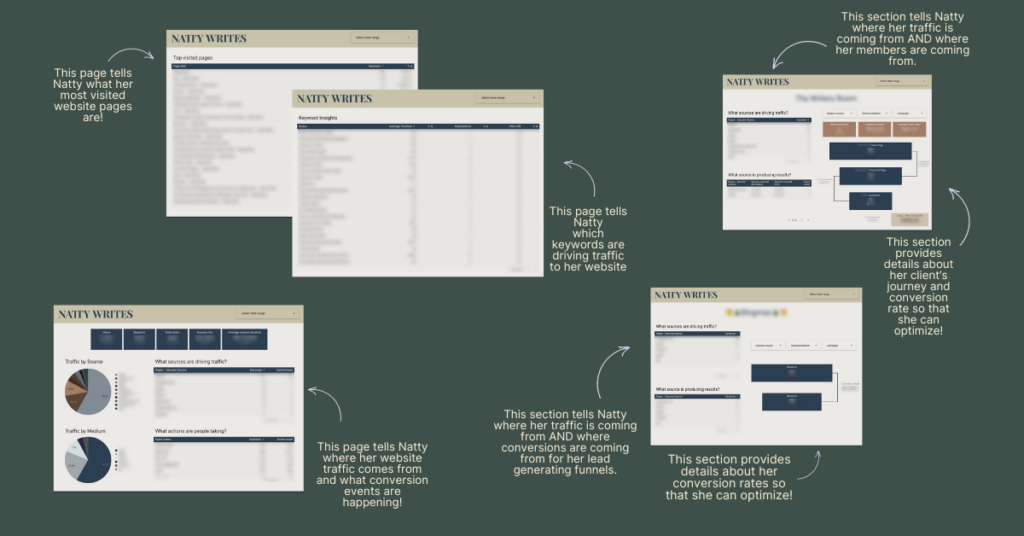
This is why I can’t recommend having a custom marketing analytics dashboard enough (like the one Rebecca creates) – it has made ALL the difference for me personally and dare I say I actually ENJOY looking at my data now?!
I mean, the dashboard is branded and everything. 😍
Ready to drive more traffic to your website through blogging?
Overall, if there’s one thing I hope you take away from this, it’s that your marketing data doesn’t feel like crickets because you’re doing something wrong…
It’s likely because there simply isn’t enough consistent activity happening on your website YET.
And truly one of the most powerful ways to change that is through blogging.
When you commit to consistent blog content, you’re not just creating something to “have” on your website.
You’re creating opportunities for:
✔️ people to find you
✔️ them to engage with your content
✔️ them to take action
✔️ data to be collected
So if you’re ready to experience all of those things and ensure that your website is truly working FOR YOU, then it’s time to get a solid blogging strategy in place for your business and get some blog posts published.
If you have no clue where to start with that, my free Beginner’s Guide is for YOU! In this guide, you’ll get:
- 4 step blog content planning process
- quarterly blog content calendar template
- guidance on how to write & structure your blog posts
- blog post outline template
- 20 blog title formulas
- 8 ways to repurpose your blogs
If you’re looking for something more hands on, my custom blog strategy service – The Manuscript – gives you 1:1 support for kickstarting blogs for your business.
With The Manuscript, you get defined blog content pillars, a quarter’s worth (up to 12) blog topics tailored to your goals and audience, PLUS ideas for how to repurpose your blogs on other platforms.
But remember: blogging is what gets the data going, but having the right systems in place is what helps you actually understand it.
So once you feel confident with your blogging efforts, working with Rebecca for a custom analytics dashboard can be a game changer!
She helps you take all of that data your blog is generating and turn it into something clear, organized, and useful, so you can see what’s working, what’s not, and where to go next in your business.
Here’s to having a website that not only looks pretty, but is truly a machine that delivers real results! 🎉


leave a comment